

hope-high-threads-triangle
from threads magazine thistle cottage studio blog
Sunday, April 3, 2011
Shirtwaists
shirtwaists
an excerpt from the ny times of 3/22
One hundred years after the Triangle Waist Company fire, the fashion that employed small armies of seamstresses at the turn of the last century endures.
The American shirtwaist was a trend that, quite literally, had legs. This brash but sensible pairing of tailored shirt and skirt offered a glimpse of the ankles, which was as rare in its day as it was freeing.
Designed for utility, the style was embraced at the turn of the 20th century by legions of young women who preferred its hiked hemline and unfettered curves to the confining, street-sweeping dresses that had hobbled their mothers and aunts.
Saturday, April 2, 2011


Thursday, March 31, 2011
Thursday, March 10, 2011
Meredith Tax: Part Of The Passage From Rivington Street Read At Triangle Commemoration At FIT
Not the entirety of this was read, but a part. My audio was not clear enough to post
tax-rivington
Kevin Baker Reading From Dreamland At Triangle Fire Commemoration At F.I.T.
part 1
part 2
part 3
from March 9
Stories and Songs of the Triangle Fire
5:30 pm, Katie Murphy Amphitheater, D Building
Meredith Tax, author, Rivington Street
Kevin Baker, author, Dreamland
Katharine Weber, author, Triangle
Songs and readings by FIT students
a few of the pages Kevin read
dreamland-pages
about the Fighting Flames exhibit that Kevin was referring to
from the jcs-group
The success of Luna Park spawned second-rate imitators. Only William H. Reynolds, a New York politician, had the clout and backing to truly compete. Reynolds bought 60 acres of land from the City of New York between Surf Avenue and the ocean. His dream was to build the most bewildering, excessive, visionary park in the world. It would hold 250,000 people. Its one million electric lights would pale Luna Park in comparison. Visitors would feel as if they had been transported to another world, so Reynolds called his park Dreamland which opened in the spring of 1904. The centerpiece of Dreamland was the 375- foot Beacon Tower. At night, its powerful searchlight shone almost 50 miles over the ocean, disorienting ships on their way into New York Harbor. The park featured an imitation Doge’s Palace, an electricity building (housing the generators that kept Dreamland’s power running) and the Fighting Flames exhibit, the six-story tenement replication that was set on fire every day.
Wednesday, March 9, 2011
Triangle Fire Memorial: CUNY TV
Former State Senator Serphin Maltese speaks about his family's connection to the Triangle Shirtwaist Factory Fire.
Bread And Roses: Labor History
A slide show I youtubed last year and forgot to post here. May be of interest with the triangle anniversary upcoming.
from Tom Juravich
from http://www.tomjuravich.com/tangled/songs/breadandroses.php
The slogan "Bread and Roses" originated in a poem of that name by James Oppenheim, published in American Magazine in December 1911, which attributed it to "the women in the West."
It is commonly associated with the textile strike in Lawrence, Massachusetts during January-March 1912, now often known as the "Bread and Roses strike." The strike, which united dozens of immigrant communities under the leadership of the Industrial Workers of the World, was led to a large extent by women.
The strikers are credited with inventing the moving picket line, so that they would not be arrested for loitering.
It was settled on terms generally favorable to the workers. They won pay increases, time-and-a-quarter pay for overtime, and a promise of no discrimination against strikers.
It has long been thought that Oppenheim was inspired by a strike sign carried by women with the slogan, "We want bread, but we want roses, too!"
We now know that he did not write it during the strike. But it was embraced by the strikers and the notion of "Bread and Roses" has become a cry for justice and dignity for women workers around the world.
Observer Ray Stannard Baker wrote in The American Magazine:
[Lawrence] is the first strike I ever saw which sang. I shall not soon forget the curious lift, the strange sudden fire of the mingled nationalities at the strike meetings when they broke into the universal language of song. And not only at the meetings did they sing, but in the soup houses and in the streets.
Bread and Roses has since become a women's movement standard with either of two melodies variously attributed to Martha L. Coleman, Caroline Kohsleet, and Carolin Kohlsaat. Utah Phillips also has a melody, as does Mimi Fariña, whose is the most well-known.
Tom Juravich adds:
For me, though, the poetry of Bread and Roses suggests a different kind of melody -- one that lends itself to a more lyrical interpretation than the march cadence of the Fariña tune. So several years ago I wrote a new melody. I also took the opportunity to revise some of the lyrics that had exhibited the sexism and racism of the early 20th century."
Bread And Roses
As we come marching, marching in beauty of the day
A million darkened kitchens, a thousand mill lofts grey
Are touched with all the radiance that a sudden sun discloses,
For the people here are singing bread and roses, bread and roses.
As we come marching, marching, unnumbered women dead
Go rising through our singing their ancient cry for bread.
Art, love, and beauty their drudging spirits knew.
Yes, it is bread we fight for but we fight for roses too.
As we come marching, marching, we
battle once again.
We're fighting for our children, our
sisters and for men.
Our lives shall not be sweated from birth
until life closes,
Hearts starve as well as bodies, give us
bread, but give us roses.
As we come marching, marching, we're
standing proud and tall,
The rising of the women means the
rising of us all.
No more the drudge and idler, ten that
toil where one reposes,
But a sharing of life's glories, bread and
roses, bread and roses.
Personnel: Teresa Healy, vocals; Tom Juravich, vocals, acoustic guitar, producer; James Stephens, fiddle, electric guitar, producer, recording, mixing; David Cain, mastering; Dave Bignell, mixing.
Patrick J. Walsh: Witness To Triangle Fire
pjwalsh
His 1946 obituary in addition to a Word War II era photo
Wednesday, February 9, 2011
From 2010: NY State Labor Commissioner Recognizes Triangle Anniversary
an excerpt from her address
Albany, NY (March 23, 2010) - State Labor Commissioner Colleen Gardner today joined state legislative and union leaders to commemorate the 99th anniversary of the Triangle Shirtwaist Company fire, which led to the tragic death of 146 garment workers. At a ceremony at the Empire State Plaza, Commissioner Gardner acknowledged the importance of the fire, which significantly changed worker protection laws.
On March 25, 1911, fire swept through the Triangle Shirtwaist Factory, trapping workers on the top three floors of a 10-story building, where exits were locked and fire escapes were defective. The tremendous public outcry that followed the tragedy led New York State to enact many of the first significant worker protection laws in the nation.
Commissioner Gardner said, "We are here to see that this tragedy never happens again. By enforcing the State's Labor Laws, the Department of Labor ensures safe working conditions for all New Yorkers. New York enacted many of the first significant worker protection laws in the nation. We continue to lead in protecting the health and safety of employees in the workplace. We honor the women who died at the Triangle Fire and stay true to our fight for workers' rights and workplace safety."
Joseph Zito: Hero Of The Triangle Shirtwaist Fire
zito1
family photos with permission of the Zito family
all rights reserved
Tuesday, February 8, 2011
The Brandos: The Triangle Fire
recorded live at the Rockpalast/Crossroads Festival at the Harmonie in Bonn, Germany on October 20, 2007
(taken from the DVD Town To Town, Sun To Sun)
In Nineteen Hundred-Nine, from Donegal's shore
I sailed to old New York town
In the harbor Lady Liberty stands
I don't believe I'll again see Dear Ould Ireland
But the promise in these city streets is so grand
And it's there I'd wed my dear, sweet lass
A bricklayer's spade, my trade to be
And she slaved at the Triangle Shirt Factory
My God! - the dreadful conditions there
They toiled through dim light and stifling air
And gruelling hours the seamstress gave
To the industrial captains for a trifling wage
Though two years passed, we saw no change
And I grieved for my love's dark misery
Then word ran through the New York streets
There's a fire at the Triangle Shirt Factory
Twas only moments and the factory surrendered to flame
And the fire escapes soon gave way
In the windows huddled girls appeared
Flames licked at their backs, their faces gripped with fear
My God! - don't jump! came the firemen's roar
Whose ladders failed to reach the top floors
A last, shared glance and final embrace
They leaped to their tragic and senseless fate
Now I scream at the sky
There's got to be a reason why
Bewildered and grieved, I'm tangled and mired
My love is gone - oh the Triangle Fire
The world is so cold, desperate and dire
I've lost everything in the Triangle Fire
There was no reason, there was no rhyme, and now law
To save us from this crime at all
The owner's trial did reveal
That the girls were locked in - the doors had all been sealed
My God! - they've gone free! came our hopeless cry
The bossed won with their lawyers and lies
The Power and Greed again prevailed
And we were left to our sorrow, to our despair
I fear the future, I can envision the time
When our cityscape will touch the sky
Will men of Faith, of Wealth and Power
Spare their people a fate like the Triangle Fire?
My God! - forgive me! these men will cry
In Their final hour as they lay dying
And their victim's ghosts close in around
God alone may forgive their indifference now
Saturday, February 5, 2011
The Life Of Working Girls In New York In 1910
working-girls-budgets
from McClures' Magazine. This was a resource for Joan Dash's book
We Shall Not Be Moved
shall-not-be-moved
a chapter from an excellent young adult book on the shirtwaist workers by Joan Dash, entitled, "We Shall Not Be Moved." I added the graphic on the last page.
Friday, January 28, 2011
Max Blanck's Tainted Epilogue
blanck-epilogue
contained within the document are pages from David von Drehle's book and google street views of where Max Blanck lived in 1900 and 1910. I don't think amyone would want to chalk those locals.
Look For The Union Label...The Tainted History of The Triangle Shirtwaist Company
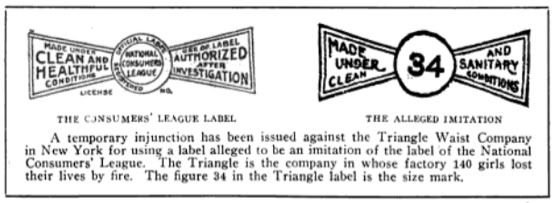
The Triangle Waist Company, New' York, was last week temporarily enjoined from using on its goods a label declared to be imitative of that of the National Consumers' League.
This is the same Triangle Waist Company in whose factory a fire killed 140 girls in 1911—it being afterward proved that doors leading from the factory, which was on the ninth floor of a loft building, had been locked.
It is the same Triangle Waist Company that, two years and six months later, was again convicted of having its doors locked, and whose head, Max Blanck, was given the minimum fine on the ground that he was a first offender.
The National Consumers' League authorizes manufacturers to use its label only after investigation has showed that the goods on which it is to be used are made under "clean and healthful" conditions. The Triangle company has never been authorized to use its label.
The label declared to be an imitation, which is here reproduced, was first discovered by the Consumers' League last spring on some goods in a Boston department store. The buyer of the store told a representative of the league that he was buying waists with the league's label on.
It required several months to trace the label to the Triangle Waist Company. An effort was then made to induce employes of the Triangle company to sign' affidavits declaring that the suspicious label was used by that concern. The employes' fear of being blacklisted among manufacturers frustrated this.
A few weeks ago' the Consumers'
League served the Triangle Company with a summons and complaint in an action for a permanent injunction and with motion papers for an injunction pending trial, until final decision could be reached, which will not be till next winter. The league's action is based on the common law rules governing unfair trade and unfair competition. The label is not a registered trademark.
The Triangle company, in its answer, admitted the use of the label, but declared that it had not intended to imitate any other label, and denied knowledge of the existence of the National Consumers' League. It also questioned the right of the league to sue, on the ground that the league is not a manufacturer of shirt waists with a financial stake involved in the protection of its label, and therefore cannot invoke the common law rules cited above.
In granting the temporary injunction. Justice Leonard A. Giegerich, of the Supreme Court of New York county, declared that he was satisfied that the Triangle Company's label was an illegal imitation. While it is felt that this decision strongly presages the granting of the permanent injunction, it is pointed out that the question of law involved is a new one.
The nearest parallel case is said to be that of labor unions, which have been granted injunctions in behalf of their labels. These decisions have, however, rested on the ground that the members of the union had a financial stake, i. c. their wages, involved.
The league contends that it is but a logical extension of the "financial stake" theory to protect it in the use of its label. In anticipation of just this point, however, Bertha Rembaugh, attorney for the league, joined both a manufacturer of waists and a retail store in the action against the Triangle Company. These concerns, it is contended, have a financial interest in the protection of the league's label because their own sales would be affected by its fraudulent imitation. Should the case go against the league, it is feared that the opening which this would give to the imitation of the league's label would go far to destroy the effectiveness of the league's label work.
Thursday, January 27, 2011

Fannie Lansner: Unsung Triangle Shirtwaist Fire Hero

Another forgotten hero is Fannie Lansner, whose selfless actions were headlined by on page two of The New York Evening Telegram of Monday March 27, 1911: “Heroic Young Forewoman Loses Her Life to Save Others from Death in Flames: Miss Fannie Lansner Guides Girls to Safety Until Her Own Escape Is Cut Off; THEN LEAPS FROM WINDOW TO DEATH ON PAVEMENT; Calm in Midst of Peril, She Does Her Utmost to Calm Panic-Stricken Women to the Last”.
“Speaking both Yiddish and English to the girls who were huddled about her, all crying and screaming, Miss Lansner guided some of them down the stairways and kept others waiting for the elevator,” the Evening Telegram reported. “Trip after trip of the elevator was made and Miss Lansner remained on the floor, and several girls begged her to go with them down the elevator, Miss Lansner said she would be ‘all right, and told them to go out as quickly as possible.”
In another account on March 30, 1911, The Hartford Courant wrote, “A number of the employees testified at the district attorney’s office to the heroism of Fannie Langner [sic], who rushed scores of girls from the eigth floor to the elevator and superintended crowding them into the car. Again and again she went into the smoke filled cutting rooms and brought out girls. Finally, she fell, exhausted and perished.”
According to the 1910 Census, Fannie live at 78 Forsyth Street.
Saturday, January 22, 2011
Subscribe to:
Posts (Atom)