Saturday, May 10, 2008

Union Square

video from pseudo-intellectualism 1/22/08
Last week I was in Union Square and I noticed the informative sidewalk installations that ring the square. I photographed most of them and supplemented them with other union square historical images. To complement them for a movie, the images needed relevant audio I struck gold when I found a great online play about labor history on wbai's site. The above encompasses the play's introduction.

Marching to Union Square: A Labor Play by Dorothy Fennel
Radio show produced by Ken Nash and Mimi Rosenberg
Marching to Union Square is about the birth of the modern trade union movement in New York City. The script is based on historical material, including speeches and memoirs, from the first Labor Day parade—held on September 5, 1882—subsequent Labor Day parades, and the 1886 mayoral campaign of Henry George, labor's candidate. Much of the action takes place in Union Square, and evokes the loud and colorful labor marches that attracted huge numbers of spectators. For a brief time in the 1880s, NYC activists tries to organize an independent labor party that could unite people of diverse backgrounds around a uniquely working class political platform. There was no better place to do this than Union Square. To express this vision in words and music from that era, the actors in Marching to Union Square recreate some of the key moments that contributed so much to Union Square's reputation as labor's home, and as the place where working New Yorkers came to exercise their rights to free speech and assembly.
Actors: George Drance, Arthur French, Todd Griffin, Mary Neufeld
Musicians: George Mann (guitar), Ginette Van Der Voorn (keyboard)
Chorus: Members of the NYC Labor Chorus, directed by Ginette Van Der Voorn

Irving Hall, Gardiner's Hall And Bernsteins

from pseudo-intellectualism 12/15/07 The map shows the 1903 location of the two halls mentioned in the news' reports about the Newsies (see below for the mention of Gardner's Hall) The movie even includes a Irving Hall as a site location. The question is would the Newsies go shopping at Bernstein's which was nearby :). The ad is from 1959
Had I known about the meeting I would have gone, since I lived at 76 Suffolk.
Here's the Tribune article about the meeting:
"Newsboys Form a New Union Elect a Man as Leader and Will Divide City Into Districts.August 3, 1899 There was a rally of newsboys at Gardner's Hall, at 21 Suffolk Street, last evening, to organize a new union and elect new officers. Abraham Lippman, who has a newsstand at Canal and Essex Streets, called the meeting to order. He is a grown-up man, and for some time he ran the meeting much to the disgust of Simon Levy, who was trying to wedge in a word without success. After some skirmishing the boys accepted a suggestion of Lippman's to have a full-grown man for a President, and elected James G. Neill, fifty years old. President Neill, in making his inauguration speech, said that the price maintained by some of the evening papers virtually imposed a tax on newsboys and newsmen, and the latter could not transfer the tax to the public as other dealers did the war tax. Mr. Neill suggested that all union boys should wear badges, and become affiliated with other labor organizations. He proposed that the city should be divided into districts and send delegates to a central union. The meeting adopted Mr. Neill's suggestions.Other officers were elected as follows: Vice President –"Racetrack" Higgins of Brooklyn; Secretary – Abe Cutler;Treasurer – Dave Ruben of Bleecker Street and the Bowery;Sergeant at Arms – "Yellow" Simon Levy. John Masin was elected head Captain, and will select his district Captains. A floral horseshoe was sent by William Reese, the colored lemonade seller in Printing House Square, for the best orator of the day. It was won by George J. Fabian."

The Internationale

from pseudo-intellectualism 7/15/06 I was lucky to catch this late last night on wnet:"In 1871, an ex-mayor named Eugene Pottier wrote a set of lyrics that called for the working masses to throw off the shackles of their oppressors. Later, a French factory worker, Pierre Degeyter, added a new melody and "The Internationale" spread rapidly through France and then Europe. The song was translated into dozens of languages and quickly became a rallying cry for communists, anarchists, and socialists worldwide. During a number of strikes, "The Internationale" unified workers of different nationalities and diverse cultural backgrounds. The song often served for multiple causes, from labor rights to the defeat of fascism in Spain, but after becoming the official anthem of the Soviet Union in 1917, many associated "The Internationale" with communism under Joseph Stalin. Slowly, though, new versions and interpretations of the song began to appear, revitalizing its connection to radical movements worldwide. The students sang "The Internationale" in Tiananmen Square, and folksinger Billy Bragg added new lyrics in the late '80s. The Internationale mixes multiple interviews with folksinger Pete Seeger and others with rare archival film footage."
I combined a midi version of the song, the English version of the lyrics, and images from Spanish Civil War posters found on orpheus.ucsd (Visual Front) to make this karaoke slide show of the Internationale

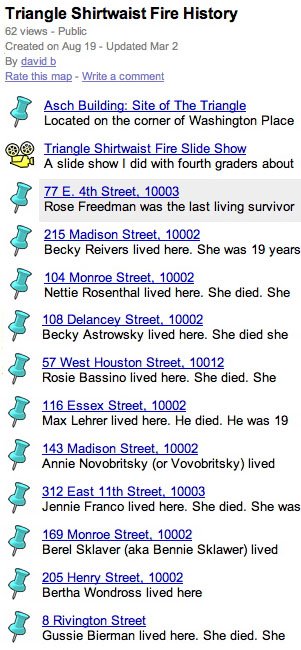
LES Triangle Victim Map

from pseudo-intellectualism 8/11/05 I created this map to give a historical LES context to Ms. Joseph's class project on the Triangle Shirtwaist Fire Victims. I utilized a very unique map created by John Tauranac as the base. Ms. Joseph had used the historical fiction title , "East Side Story," along with archival information from Unite's (the former ILGWU) web site, ilr.cornell.edu/trianglefire/. Her students wrote stories with characters placed back in time with that era. They also made posters protesting working conditions simulating what the shirtwaist workers did in the 1909 strike. They brought much of this material with them as special guests of the UFT's District Representatuve, Donna Manganello, to the annual commemoration that takes place at the site of the fire. Their work was recognized by the President of Unite, Bruce Raynor, and they had the honor to be invited onstage for the official ceremony. Portions of this were broadcast locally on ny1.com.

Triangle Follow Up

from pseudo-intellectualism As mentioned previously on 8/8/05 posting; Ms. Joseph's fifth graders at the Triangle Shirtwaist Commemoration sponsored by Unite on March 26, 2005. Here's a clip from ny1.com where you can see a group of students with their work on stage. Mr. Maltese is referring to the following information from David von Drehle's recent book on the Triangle Fire: http://www.groveatlantic.com/grove/wc.dll?groveproc~misc~2620
MALTESE, Catherine, asphyxiation/burns. 35 Second Ave. Identified on December 18, 1911, when her husband, Serafino, finally recognized one of her possessions. Mother of Lucy and Sara. Leon Stein, The Triangle Fire, p. 204.
MALTESE, Lucia “Lucy,” 20, asphyxiation/burns. 35 Second Ave. Identified by her father Serafino. Sister of Sara, daughter of Catherine. Multiple newspapers, March 27.
MALTESE, Rosaria “Sara,” 14, asphyxiation/burns. 35 Second Ave. Identified by her father Serafino. Sister of Lucy, daughter of Catherine. Multiple newspapers, March 27.

Pauline Pepe: Triangle Fire Survivor


from pseudo-intellectualism 8/6/05
The victims of the triangle fire, NYC circa the era of Witch of 4th Street, were mostly Jewish and Italian. Here's a story about it from the Kisseloff book. The image shows the damage and the factory owners.

Triangle Shirtwaist Fire 2

video
from pseudo-intellectualism 12/13/07
A slide show I did in 2001 with fourth graders about the Triangle Shirtwaist Fire. They had just read "East Side Story" and then we researched where some of the victims lived.
Some lived within a few blocks of Knickerbocker Village. Nettie Rosenthal lived at 105 Monroe Street (between Market and Pike). She was 21 years old. Another victim lived at 55 Pike Street and another at 177 Cherry Street
The Triangle Shirtwaist Factory fire in New York City on March 25, 1911, was the largest industrial disaster in the history of the city of New York, causing the death of 146 garment workers who either died from the fire or jumped to their deaths. It was the worst workplace disaster in New York City until September 11th, 2001. The fire led to legislation requiring improved factory safety standards and helped spur the growth of the International Ladies' Garment Workers' Union, which fought for better working conditions for sweatshop workers in that industry. The Triangle Shirtwaist Factory Building, also known as the Asch Building and as the Brown Building, survives and was named a National Historic Landmark.

blogger templates | Make Money Online